

Key takeaways
Business process automation, RPA and AI agents solve different problems, not different versions of the same problem. Choosing the wrong type wastes budget even when the decision to automate was correct. This article sets out what separates the three, a way to match each to your operation, and where ONGC’s business process automation service fits into that sequence.
What’s below
- What automation options do I have for my business?
- Do I need business process automation for a multi-step process?
- Do I need RPA for tasks that span disconnected systems?
- Do I need an AI agent for tasks that require judgement?
- How do I choose between Business process automation vs RPA vs AI agents?
- How do I get started with business process automation?
- The bottom line
Business process automation services, RPA and AI agents are marketed as though they solve the same problem. They do not. Pick the wrong category, and the tool gets matched to the trend, not the process it is meant to serve.
In fifteen years working inside Dynamics 365 and automation implementations, the costliest mistake I have watched a business make was never a badly configured tool. It was choosing one before the process they want to automate has been fully understood.
This article works through what separates business process automation, RPA and AI agents, and how to match each to your goal. Fit comes first. The framework only earns its budget once the goal it is meant to achieve and process it’s meant to streamline has been identified correctly, not the other way round.
Separating the three starts with knowing what each one is built to do.
What automation options do I have for my business?
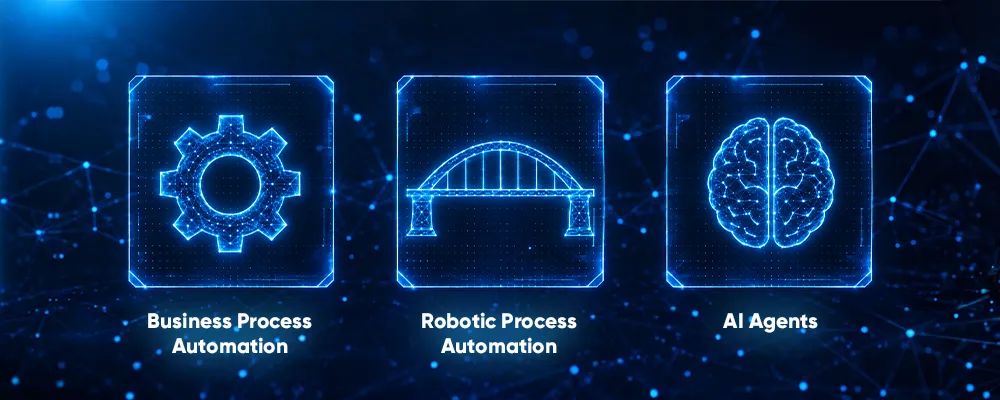
Business process automation, RPA and AI agents are three distinct categories, separated by how much judgement a task requires and how many systems it touches.
Line those two questions up against the process in front of you, and the category becomes clear before you look at a single product name. Get the sorting wrong at this stage, and every decision that follows inherits the same mistake.
Do I need business process automation for a multi-step process?
Business process automation applies a fixed set of rules across an entire process, coordinating each step in sequence without requiring a decision along the way. It is the gear train, each part turning together to keep the whole process moving.
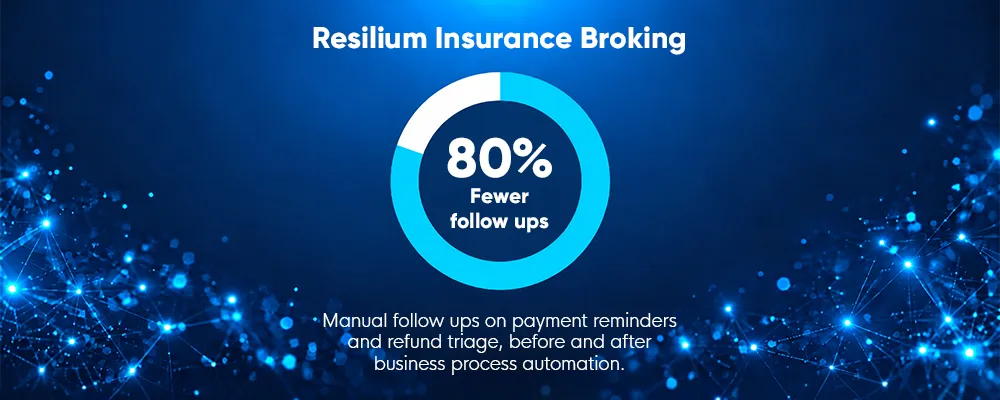
It suits processes with several steps that need to happen in order, such as chasing a payment through escalating follow-ups, routing an approval, or working through a multi-stage reporting cycle. Resilium Insurance Broking used this category to automate payment reminders and refund triage, replacing a process that previously required 15 to 25 manual follow-ups a week per representative with a consistent, rules-based sequence.
The same pattern applies to invoice chasing in an accounting practice, or onboarding steps in a real estate transaction. The test is simple. If the process follows the same sequence of steps every time without anyone needing to make a judgement call, BPA is a candidate.
Do I need RPA for tasks that span disconnected systems?
RPA, robotic process automation, automates a specific task that spans systems that do not otherwise talk to each other, without replacing any of those systems. It is the bridge, not a replacement for either system.
RPA works at the level of a single task, rather than an entire process. It is no-code or low-code, and it works by mimicking human interaction directly with existing software, moving data between systems the same way a staff member would, one login and one screen at a time. This suits a task that crosses several platforms with no native integration between them, moving a new client’s details from a practice management system into an accounting package, for example. RPA does not replace those systems. It sits on top of them and closes the gap between them.
Do I need an AI agent for tasks that require judgement?
AI agents apply judgement to a task, assessing data and context to decide what happens next rather than following a fixed set of steps. It is the brain, brought in where the other two categories cannot go.
This suits work that involves generating insight, supporting a decision, or drafting content, rather than completing a repeated action.
Turning data into direction
Ecosure, one of Australia’s largest specialist environmental consultancies, used Microsoft Copilot and Power BI to turn operational data into decision-ready insight and support RFP drafting, work that depended on interpretation rather than repetition.
How do I choose between Business process automation vs RPA vs AI agents?
Match the category to the task. A process with several steps that need to happen in sequence points to business process automation, a single repetitive task, particularly where systems do not talk to each other, points to RPA, and work requiring judgement or insight points to AI agents.
The filter is straightforward once the categories are separated. If the task follows the same sequence of steps every time, business process automation is the fit. The distinction between RPA vs AI agents comes down to judgement. If it depends on moving data between systems never built to talk to each other, RPA is the fit. If the outcome depends on interpreting information rather than repeating a step, an AI agent is the fit.
A single business can apply more than one category to different processes, rather than looking for one answer that covers everything. The question is not which category is best. It is which category matches the process in front of you.
How do I get started with business process automation?
ONGC’s business process automation service covers the multi-step, sequence-driven workload category, sitting under Automation and Analytics alongside the AI and automation assessment and Power BI implementation, each addressing a different category.
For Resilium, that service cut manual follow ups by around 80 percent and let the team handle a higher volume of refund requests without adding headcount, the outcome of matching the category to the task correctly. If the category is still the open question for your operation, the AI and automation assessment is built to answer that before you commit to an implementation.
Explore this with ONGC’s Microsoft Copilot and AI Enablement team.
The bottom line
Business process automation, RPA and AI agents answer three different questions, not three versions of the same one. One handles rule-based repetition, one closes the gap between disconnected systems, and one applies judgement where a person would otherwise have to. Get the category right, and the budget goes to work. Get it wrong, and the technology gets blamed for a decision that was never really about the technology.
Talk to ONGC’s Business process automation team about where to start.